darrentech.uk

My first QSO

A very brief post about my first ever QSO (2-way contact), in my living room. With my G90, a homemade 49:1 unun, and roughly 20m of wire strewn across my flat.

Mostly a collection of pictures of the experience. Since getting my Foundation radio licence I have been toiling away building up all the things I need to make contacts across the world.

Eventually I built my 49:1 unun with some very ugly solder joints, I have yet to set this up outside hanging from a tree, where I will get an incredibly better signal for both transmitting and receiving. But in the meantime I gave it a shot throwing a wire around my flat and seeing what I could pick up.

I had initially set my G90 to the wrong frequency, so I was sitting for about 20 minutes or so hearing nothing, but I did eventually figure this out and saw some real messages start flowing through. The evening finished up when I managed to actually have a “conversation” (wherein our radios beeped digital signals at each other) over 507 miles apart with a fellow in Norway! Which I find very cool that this is possible with some wire and some wattage.

Next steps here will be to get this setup semi-permanently in a tree in my garden, and then try to make a QSO over voice (SSB modulation), and see how far/many I can get with the digital modes as well!

Very exciting stuff,

73
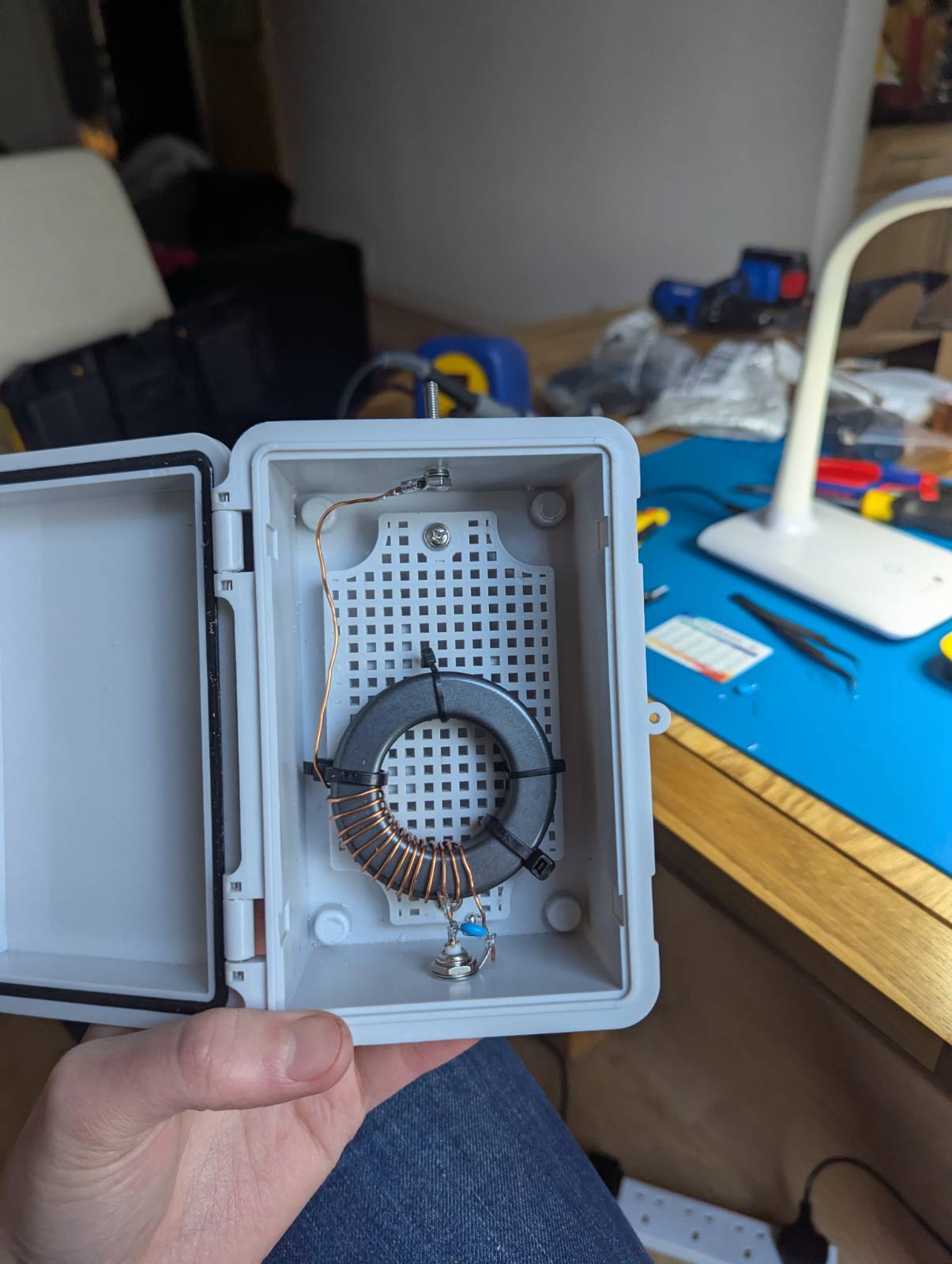
An open grey plastic enclosure held in one hand. Inside, copper wire is wound around a dark ferrite ring cable-tied to a mounting grid, with a small blue capacitor at the coax socket at the bottom and a metal stud at the top.
The home-built 49:1 unun: the transformer winding on a ferrite toroid, a small blue capacitor across the coax input, and a stud on top for the antenna wire, in a weatherproof box.
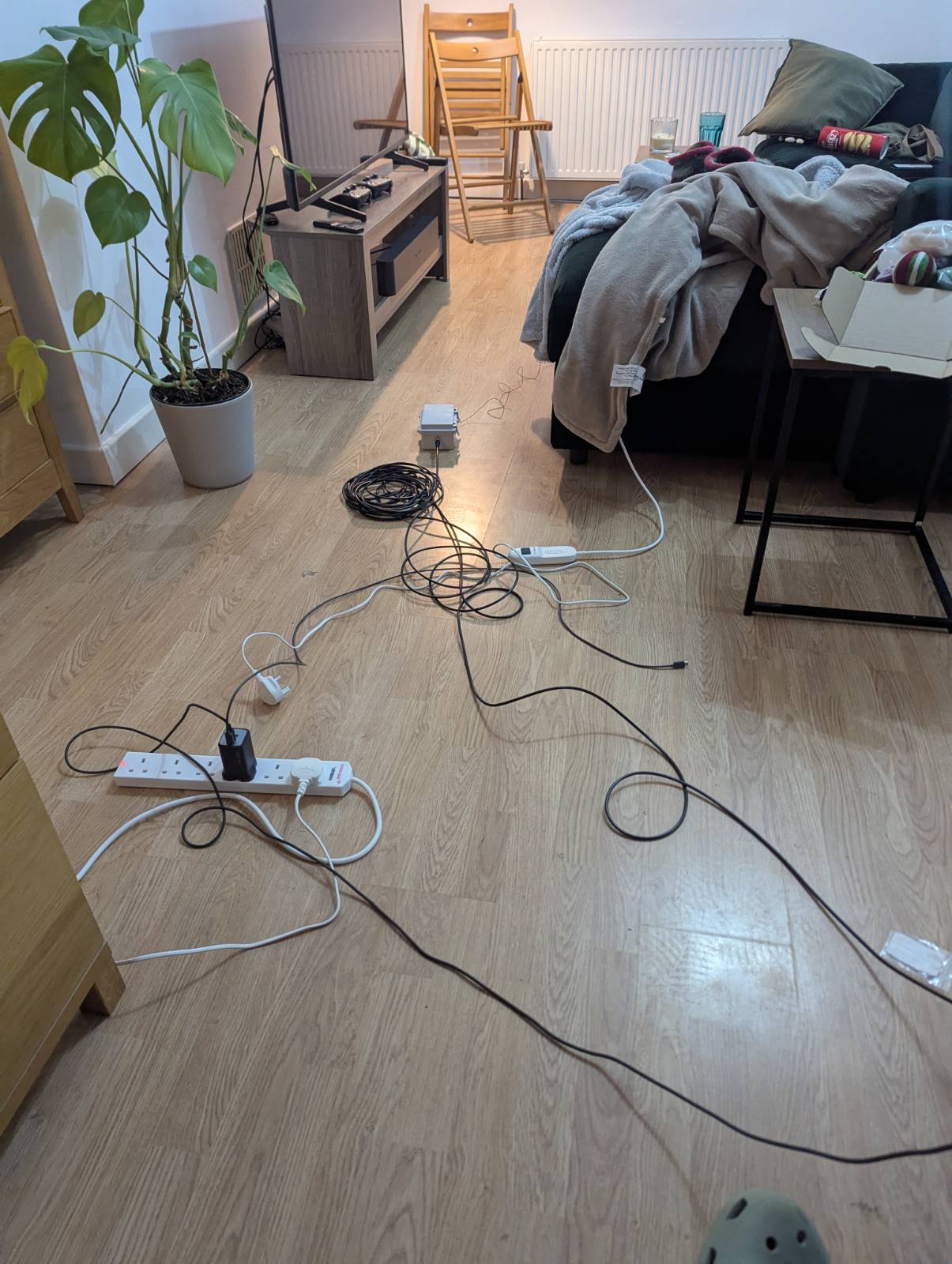
A living-room floor with the grey unun box in the middle, a coil of black coax beside it, and thin black wire running across the laminate past a sofa, with extension leads among the cables.
The test antenna: about 20 m of wire, cut as a 40 m end-fed half-wave, laid across the living-room floor from the unun, with the spare coax coiled beside it.
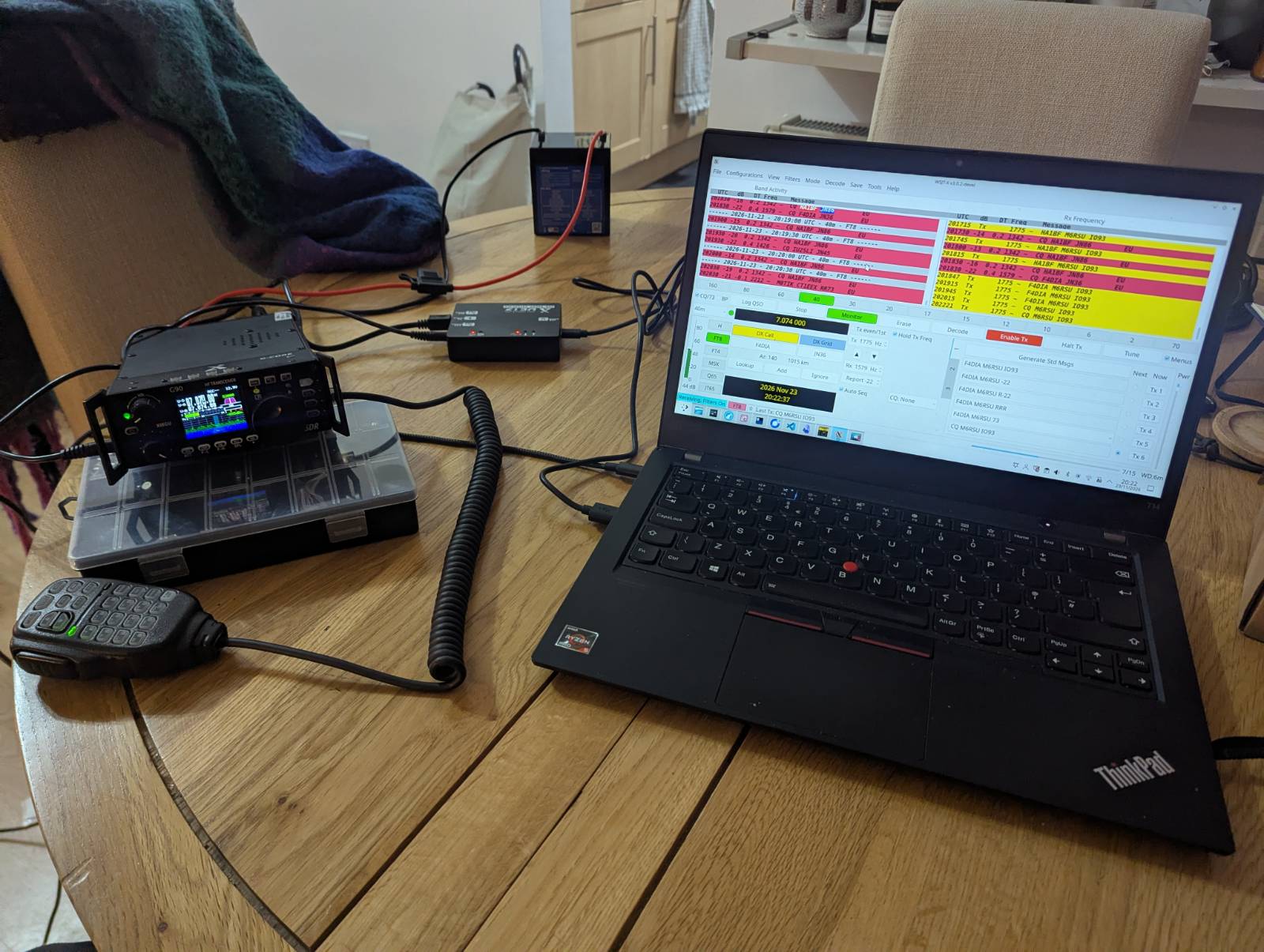
A Xiegu G90 radio on a clear parts box with a hand microphone in front, a small black DE-19 interface behind it, a 12 V battery, and a ThinkPad laptop showing WSJT-X with decoded messages highlighted in red and yellow.
The operating position: the Xiegu G90 with the DE-19 data interface behind it, a 12 V battery, and WSJT-X on the laptop mid-exchange at 20:22 UTC.
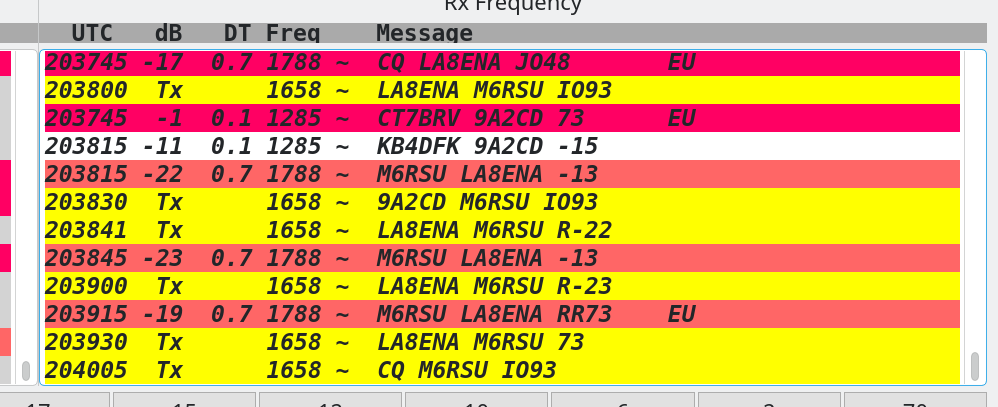
The WSJT-X Rx Frequency pane listing timestamped FT8 messages between LA8ENA and M6RSU, received lines in red and transmitted lines in yellow.
The contact as WSJT-X logged it. LA8ENA calls CQ, I answer, he reports me at −13 dB, I send R-23, he confirms with RR73, and I sign off with 73 at 20:39:30 UTC.
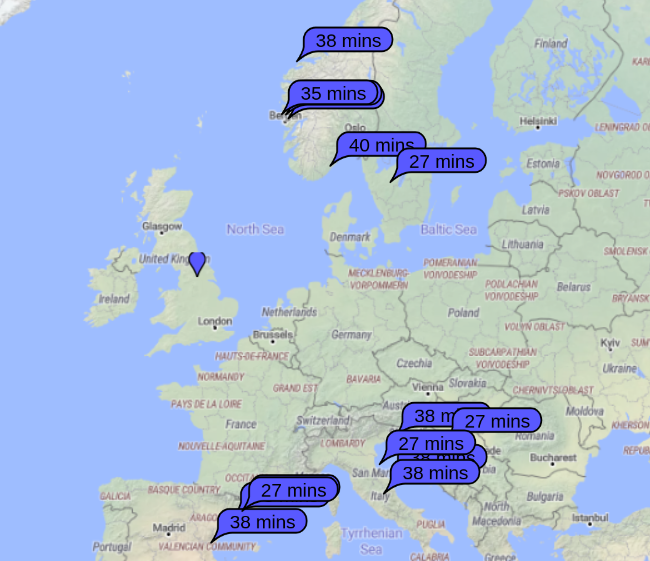
A map of Europe with a marker in northern England and labelled markers in Norway, Sweden, Spain, Italy and Croatia showing minutes since each reception report.
PSK Reporter at 21:16 UTC: the stations that decoded my CQs, from Norway and Sweden down to Spain, Italy and Croatia. The labels show minutes since each report.
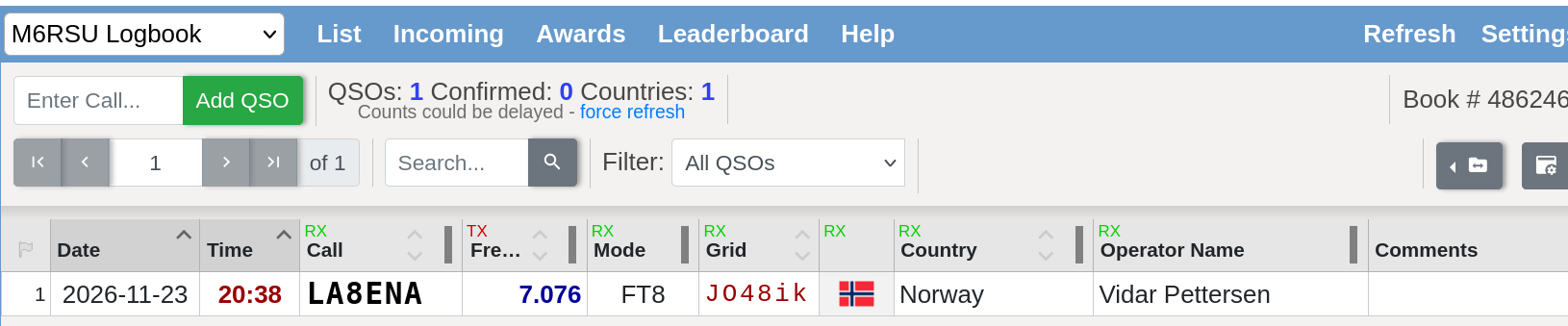
The M6RSU logbook on QRZ.com showing one entry: LA8ENA, 2026-11-23 at 20:38, 7.076 MHz, FT8, grid JO48ik, Norway.
The contact in my QRZ.com logbook: LA8ENA in Norway, 20:38 UTC on 7.076 MHz, FT8. Logged, but not confirmed yet.

← blog